



Queensland Silica Compliance in 2026: What Changes on 1 December
On this page
- From 1 December 2026, Australia's workplace exposure standards will be replaced by workplace exposure limits. For respirable crystalline silica, the value remains 0.05 mg/m³ as an eight-hour time-weighted average.
- A crystalline silica substance, or CSS, is material containing at least 1% crystalline silica by weight. Queensland's strengthened requirements for processing CSS have applied since 1 September 2024.
- A PCBU must undertake air monitoring where it is not certain on reasonable grounds whether exposure exceeds the applicable exposure standard, or where monitoring is necessary to determine whether there is a risk to health.
- Workers who may be involved in, or exposed because of, high-risk CSS processing must receive crystalline silica training. In Queensland, this can be a VET-accredited course or training that meets the regulator-approved criteria.
What changes on 1 December 2026?
From 1 December 2026, Australia’s workplace exposure standards will become workplace exposure limits.
For respirable crystalline silica, the number itself does not change. The limit remains:
0.05 mg/m³ as an eight-hour time-weighted average.
Importantly, this is already the legal maximum. The December change is largely about terminology and making it clearer that the figure is a limit that must not be exceeded, not a target or guideline.
For PCBUs, the practical requirement remains the same: silica exposure must be eliminated where reasonably practicable, or otherwise minimised so far as reasonably practicable.
What counts as a crystalline silica substance?
Since September 2024, Queensland’s silica requirements have applied to crystalline silica substances, or CSS.
A CSS is any material containing at least 1% crystalline silica by weight.
That means the requirements go well beyond engineered stone. They can apply to common materials including concrete, bricks, pavers, tiles, mortar, natural stone and other silica-containing products.
Tasks such as cutting, drilling, grinding, crushing and demolition can release respirable crystalline silica into the worker’s breathing zone.
Where CSS processing is identified as high risk, PCBUs may need a silica risk control plan, appropriate control measures, worker training and, depending on the level of risk, health monitoring.
When is silica air monitoring required?
Air monitoring is required where a PCBU cannot be certain on reasonable grounds that worker exposure remains below the applicable limit, or where monitoring is needed to determine whether there is a risk to health.
That is an important distinction.
Silica content alone does not tell you the level of worker exposure. Exposure depends on the task, duration, environment, ventilation, equipment and controls being used.
A defensible monitoring program should therefore reflect the actual work being performed.
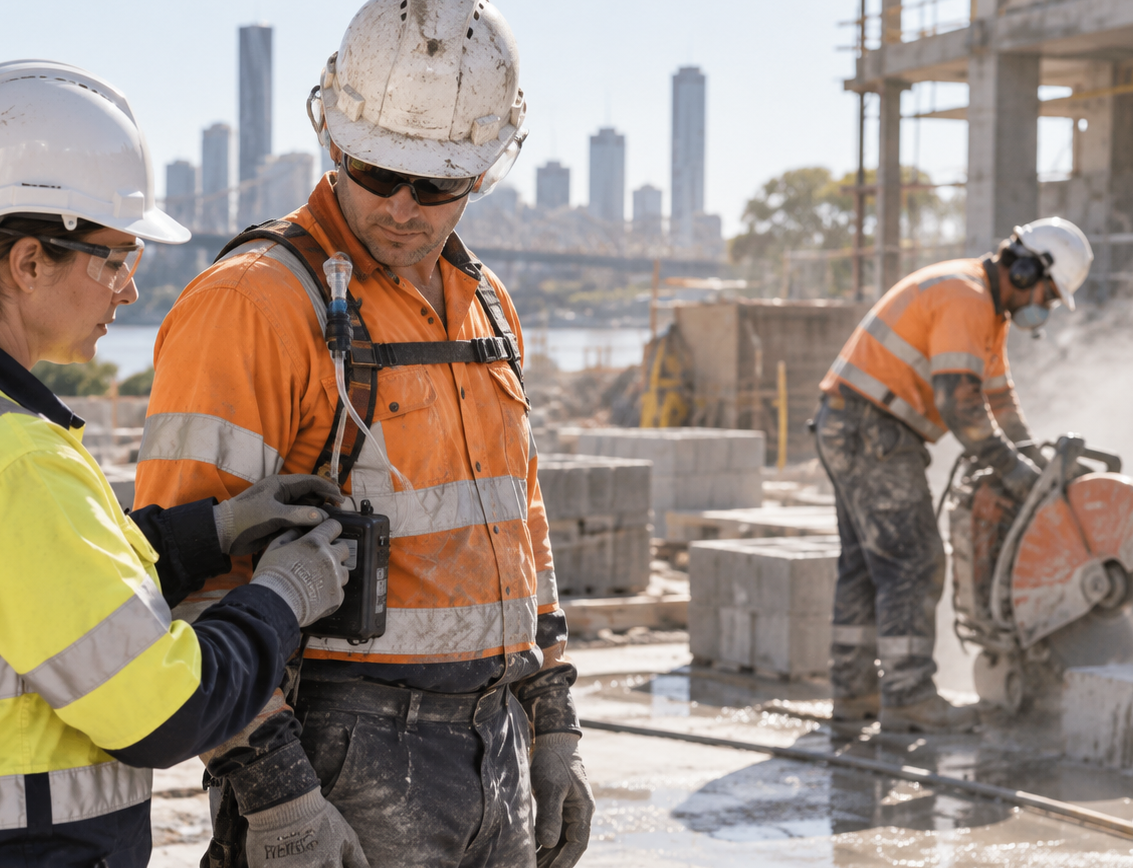
For respirable crystalline silica, personal exposure monitoring is typically undertaken in accordance with AS 2985, with laboratory analysis by an appropriately accredited laboratory.
The purpose is not simply to produce a number. Monitoring should help establish who is being exposed, during what activities, and whether the controls in place are working effectively.
What happens if a result exceeds 0.05 mg/m³?
A result above 0.05 mg/m³ requires action.
The PCBU should review the task and controls, identify why the exceedance occurred and determine what needs to change before the work continues under the same conditions.
That may include reviewing wet methods, local exhaust ventilation, isolation, equipment selection, work practices or respiratory protection.
In Queensland, where high-risk CSS processing is being undertaken and air monitoring identifies an exceedance, the result must also be reported to Workplace Health and Safety Queensland within the required timeframe.
A result below 0.05 mg/m³ should not automatically be treated as proof that the risk is adequately controlled either. The broader duty remains to minimise exposure so far as reasonably practicable.
Queensland mines and quarries
Mineral mines and quarries operate under a separate regulatory framework administered by Resources Safety and Health Queensland.
For these sites, QGL02 provides guidance on the management of respirable dust, including RCS monitoring, control and reporting requirements.
This matters for businesses working across construction, civil, quarrying and resources because the applicable monitoring and reporting framework can depend on the type of site.
What should PCBUs review before December?
The December change is a useful point for businesses to review their silica management systems.
PCBUs should be able to demonstrate that they understand which materials and tasks create silica exposure, have assessed high-risk processing, are using appropriate controls, have trained relevant workers and know when air and health monitoring obligations are triggered.
They should also have a clear process for reviewing monitoring results, responding to elevated exposure and reporting exceedances where required.
The key point is simple:
0.05 mg/m³ is not changing on 1 December. The expectation that silica exposure is properly understood, controlled and verified remains.
Where BBN fits
BBN supports clients with respirable crystalline silica exposure assessments, personal air monitoring, monitoring strategies and interpretation of results.
Our occupational hygiene team can help establish baseline exposure, assess whether controls are working effectively and provide practical recommendations where further action is required.
With the transition to workplace exposure limits approaching, the objective is not simply to prepare for a new name on 1 December. It is to have a silica management program that can demonstrate effective control of worker exposure.
Frequently asked questions
What changes for silica on 1 December 2026?
Australia moves from workplace exposure standards to workplace exposure limits on 1 December 2026. For respirable crystalline silica, the numerical value remains 0.05 mg/m³ as an eight-hour time-weighted average. Importantly, the existing WES is already legally enforceable, so the underlying duty not to exceed the limit does not begin in December.
What is a crystalline silica substance?
A crystalline silica substance is material containing at least 1% crystalline silica by weight. This can include concrete, bricks, pavers, tiles, mortar, stone and many other construction materials. Cutting, grinding, drilling, crushing or otherwise processing these materials can release respirable crystalline silica into the worker's breathing zone.
When is silica air monitoring required in Queensland?
Air monitoring is required where a PCBU is not certain on reasonable grounds whether airborne RCS exceeds the applicable exposure standard, or where monitoring is needed to determine whether there is a risk to health. Queensland guidance supports representative personal sampling undertaken using recognised occupational hygiene methods, including AS 2985 for RCS sampling.
Does the engineered stone ban mean silica is no longer a problem?
No. The engineered stone prohibition addresses one major source of RCS exposure, but silica occurs in many other materials including concrete, bricks, pavers, tiles, mortar and natural stone. Queensland's crystalline silica substance requirements apply more broadly to materials containing at least 1% crystalline silica and their processing across industries.