



Asbestos Air Monitoring: When You Need It and What the Results Mean
On this page
- Air monitoring answers whether the air is safe with a number instead of a hunch. Results are reported in fibres per millilitre of air.
- Three kinds do different jobs. Control monitoring runs outside the work area during removal, exposure monitoring measures a specific worker's breathing zone, and clearance monitoring happens before an area is reoccupied.
- The headline figure is 0.01 fibres/mL. Below it, controls are working. Between 0.01 and 0.02, controls must be reviewed. Above 0.02, work stops until the cause is found.
- For friable (Class A) removal, control and clearance monitoring are both required, and the clearance certificate must be issued by an independent licensed asbestos assessor with no connection to the removal contractor.
Asbestos removal does not end when the last sheet is bagged. The question that matters to a property owner, builder, or facility manager is simpler and harder: is the air now safe to breathe? Air monitoring is how that question gets answered with a number instead of a hunch. Yet it is one of the most misunderstood parts of any asbestos job, and getting it wrong can leave a site occupied while fibres are still airborne, or hold up a handover that should have proceeded.
Here is what asbestos air monitoring actually is, when the law requires it, and how to read the results.
What air monitoring measures
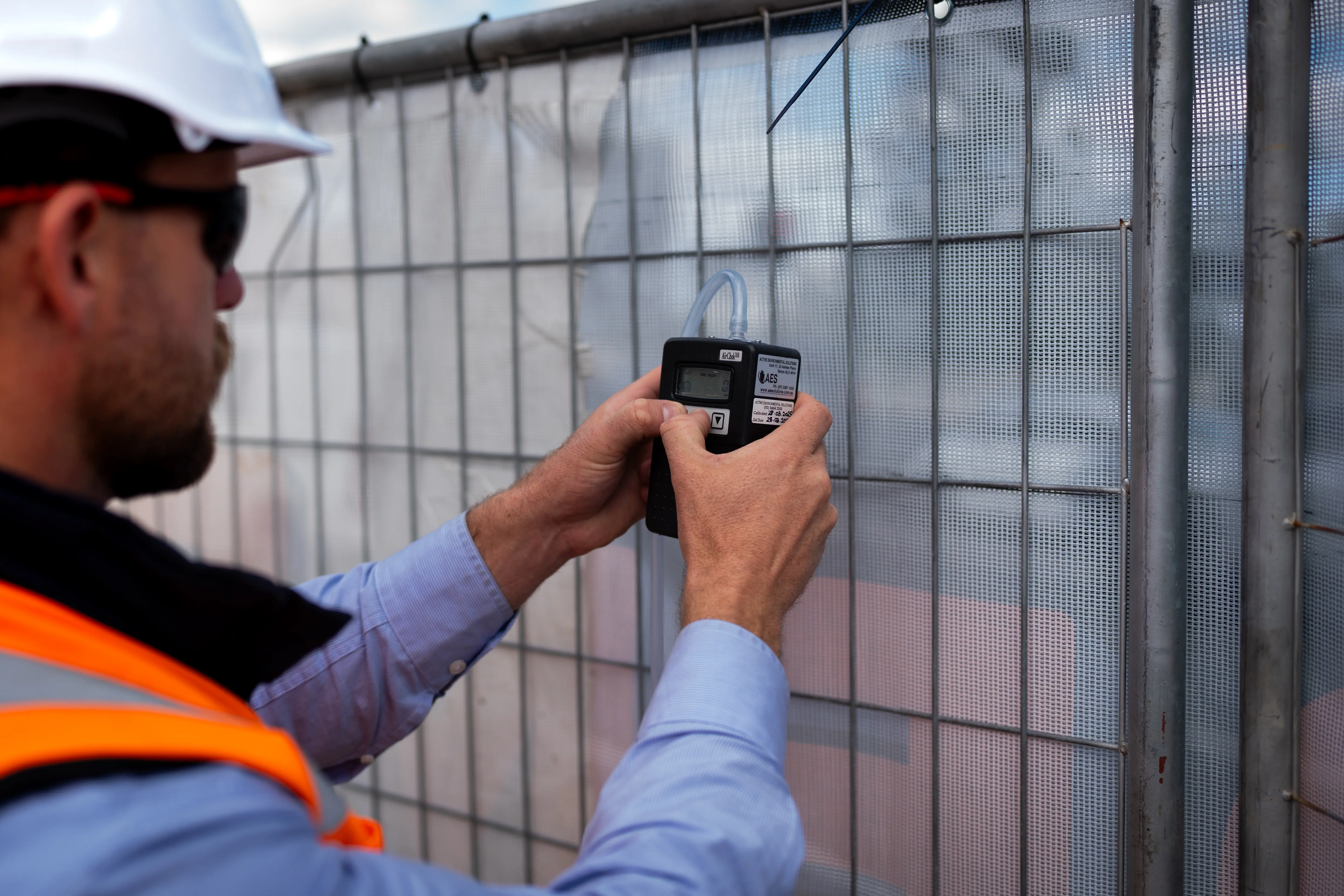
Asbestos air monitoring estimates the concentration of respirable asbestos fibres in a given volume of air. Samples are collected by drawing a measured quantity of air through a membrane filter using a calibrated sampling pump. The filter is then prepared and examined under a phase contrast microscope, where an analyst sizes and counts fibres against defined geometric criteria using a calibrated eyepiece graticule. The result is expressed as fibres per millilitre of air (fibres/mL).
In Australia this work is carried out in accordance with Safe Work Australia’s Guidance Note on the Membrane Filter Method for Estimating Airborne Asbestos Fibres (NOHSC:3003, 2nd edition, 2005) — universally referred to as the membrane filter method. It is the reference method every competent analyst follows, and the reason results from different laboratories can be compared at all.
The three kinds of monitoring
Not all air monitoring serves the same purpose, and confusing them is where projects come unstuck.
Control monitoring runs during removal work. It is conducted outside the work area — typically at the boundary of the enclosure or exclusion zone — to confirm the controls in place are keeping fibres contained. It does not measure what a worker inside the enclosure is exposed to; it tells you whether asbestos is escaping into areas where other people are present.
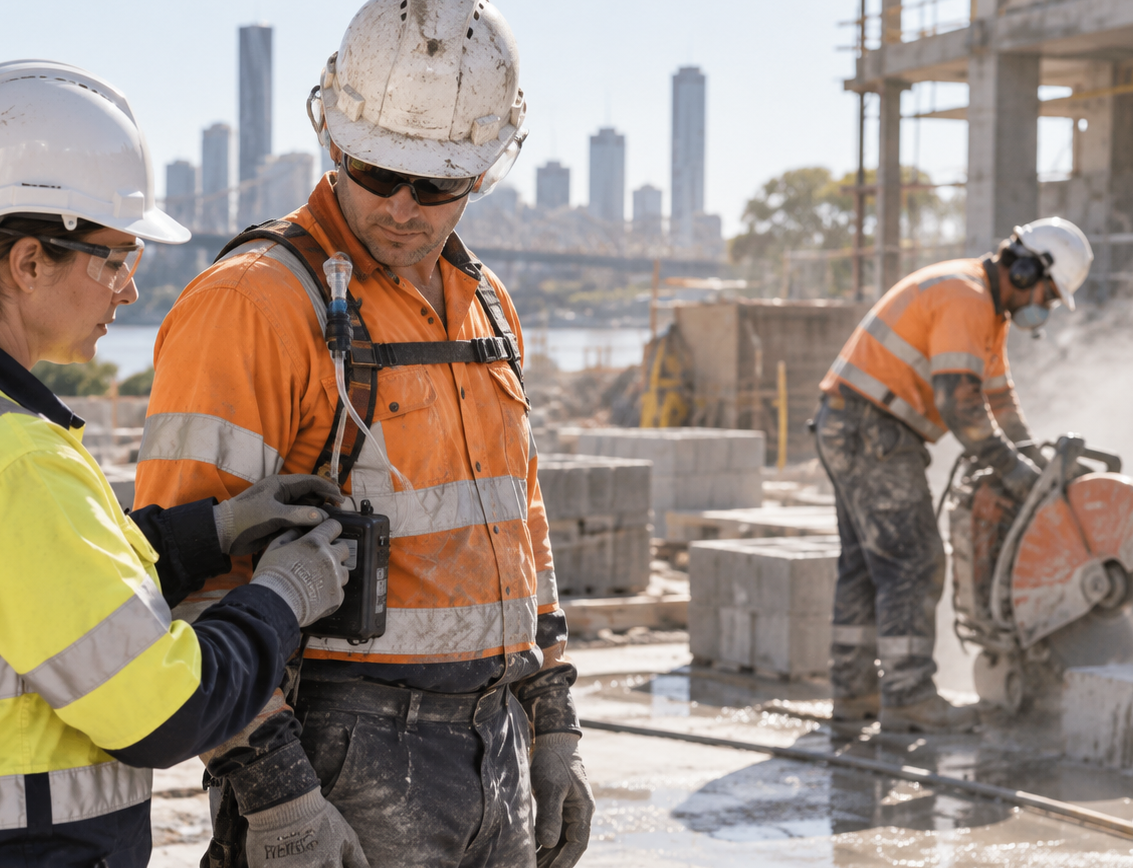
Exposure monitoring measures the airborne fibre concentration in the breathing zone of a specific worker, to assess that individual’s exposure against the workplace exposure standard. It is about the person, not the perimeter.
Clearance monitoring happens at the end of the job, before an area is reoccupied or an enclosure is dismantled. It is part of confirming the area is safe to return to normal use.
Reading the numbers
The headline figure for both control and clearance work is 0.01 fibres/mL. An area is generally considered clear when airborne asbestos is measured below this concentration.
During control monitoring, the results trigger defined actions:
- Below 0.01 fibres/mL — controls are working; removal may continue.
- Between 0.01 and 0.02 fibres/mL — control measures must be reviewed and improved before work continues.
- Above 0.02 fibres/mL — work must stop until the cause of the elevated reading is identified and brought under control.
These thresholds are not arbitrary targets to be negotiated. They are decision points. A reading of 0.015 fibres/mL is not a “pass with a note”; it is an instruction to review what is happening on site before anyone goes further.
When the law requires it
Under the Work Health and Safety Regulation 2011 (Qld) and the associated codes of practice, air monitoring is mandatory in defined circumstances — most importantly for friable (Class A) asbestos removal, where control monitoring during the work and clearance monitoring inside the enclosure before it is taken down are both required. For friable removal, the clearance inspection and clearance certificate must be issued by an independent licensed asbestos assessor who is not connected to the removal contractor.
For non-friable (Class B) removal, air monitoring is not always mandatory, but it is frequently sensible — for example where removal is occurring in or near an occupied building, a school, a healthcare facility, or any setting where the people nearby need documented assurance rather than verbal reassurance. Independence matters here too: the party verifying the air should not be the party that did the removal.
Why the analysis behind the number matters
A fibre count is only as reliable as the analyst and the laboratory behind it. The membrane filter method depends on consistent slide preparation, correctly calibrated equipment, and a counter trained to apply the counting rules the same way every time. This is precisely the kind of work that belongs in an accredited laboratory environment. BBN operates an asbestos identification laboratory in southeast Queensland that is working towards NATA accreditation for asbestos analysis under AS 4964, alongside our occupational hygiene and air monitoring capability — so the sampling in the field and the analysis behind it are held to a single, defensible standard.
What BBN delivers
BBN Consulting plans and conducts asbestos air monitoring across removal, refurbishment, and demolition projects on the Sunshine Coast and throughout Queensland — control monitoring during works, exposure assessment where workers are at risk, and independent clearance monitoring and certification for friable removal. As an Australian environmental intelligence company specialising in hazard identification and management across contaminated land, the built environment, and occupational settings, we treat each result as a decision point, not a box to tick.
If you have asbestos removal planned, or you need independent verification that an area is safe to reoccupy, contact BBN to scope the right monitoring for your site before work begins.
.jpg)