



PFAS Rules Are Tightening: What the 2026 NEMP Update Means for Queensland Landowners and Developers
On this page
- The national framework for managing PFAS was substantially revised through 2025 and 2026, and the values that decide whether a site is clean have come down.
- Past clearances are not a guarantee. A site assessed as acceptable a few years ago may not meet today's values, and lenders, insurers and regulators are alert to that gap.
- Groundwater is the quiet risk. PFAS migrates well beyond a source area, so a problem can originate off your land and still affect your project.
PFAS contamination has moved from a niche regulatory concern to a mainstream due diligence issue, and the rules governing it are getting stricter. Through 2025 and into 2026, the national framework for managing PFAS in soil and water has been substantially revised, and the guideline values that decide whether a site is ‘clean’ have come down. If you own, develop, or manage land in Queensland, that shift changes what a contaminated land assessment needs to look for, and what a site is worth.
What PFAS is, and why it lives in your soil
Per- and poly-fluoroalkyl substances (PFAS) are a large family of manufactured chemicals used for decades in firefighting foams, industrial processes, and a range of consumer products because they resist heat, water, and grease. The same durability is the problem. PFAS do not readily break down, which is why they are often called ‘forever chemicals’. They accumulate in soil, migrate into groundwater and surface water, and persist for generations.
For landowners, the practical consequence is that PFAS can be present on a site with no visible sign at all. Former industrial premises, fire training grounds, airports, defence land, waste facilities, and properties downgradient of any of these can carry a legacy that only surfaces in a soil or groundwater sample.
What changed: NEMP 3.0 and the 2026 update
The PFAS National Environmental Management Plan (NEMP) is Australia's national guide for managing PFAS contamination. It is developed jointly by the Commonwealth, state and territory, and New Zealand governments through the Heads of EPA Australia and New Zealand (HEPA), and it shapes how regulators and consultants assess contaminated sites across the country.
On 4 March 2025 the Commonwealth released PFAS NEMP 3.0, the most significant overhaul of the plan to date. It introduced revised health-based and ecological guideline values for soil, surface water, groundwater, and biota, and placed a stronger emphasis on the remediation hierarchy — prioritising treatment of PFAS over disposal to landfill. It also added guidance on how to demonstrate that remediation has actually worked, and how to manage long-term residual risk where contamination cannot be fully removed.
That work has continued into 2026. PFAS NEMP 3.1 incorporates updated guideline values for PFOS in fresh and marine water, following revised values released by the Australian and New Zealand Guidelines for Fresh and Marine Water Quality (ANZG) in March 2026. The direction of travel is clear: the thresholds are tightening, not loosening.
Drinking water values have already dropped
The pressure is not limited to the NEMP. In June 2025 the National Health and Medical Research Council (NHMRC) updated the PFAS values in the Australian Drinking Water Guidelines, lowering the figure for PFOS to 8 nanograms per litre, alongside values of 200 ng/L for PFOA, 30 ng/L for PFHxS, and 1000 ng/L for PFBS. Lower water thresholds matter for land because groundwater is often the pathway that connects a contaminated site to a receptor.
More PFAS chemicals are being captured
The list of regulated substances is also growing. A Commonwealth consultation on proposed environmental standards for additional PFAS chemicals — including PFHpS, PFNS, and PFBS — under the Industrial Chemicals Environmental Management Standard (IChEMS) closed on 24 April 2026, with outcomes expected before the end of June 2026. Substances that were not previously a focus of assessment may soon need to be.
What this means for owners, developers, and managers
Tighter guideline values have a direct commercial effect. A concentration that passed an assessment under earlier criteria may exceed the current values, which can change a site's classification, its permitted land use, and the cost of making it development-ready.
For anyone buying, selling, or developing land, the implications are practical:
- Due diligence needs to cover PFAS explicitly. A general contaminated land review that does not consider PFAS sources and pathways is no longer sufficient on sites with any relevant history.
- Soil disposal is getting more expensive and more scrutinised. With the remediation hierarchy favouring treatment over landfill, excavate-and-dump is not always the cheapest or the approved option.
- Past clearances are not a guarantee. A site assessed as acceptable a few years ago may not meet today's values, and lenders, insurers, and regulators are increasingly alert to that gap.
- Groundwater is the quiet risk. PFAS can migrate well beyond a source area, so a problem can originate off your land and still affect your project.
In Queensland, assessment of site contamination is carried out under the national framework, and investigations should be designed and signed off by a suitably qualified person. PFAS adds a layer to that work: the sampling strategy, laboratory methods, and screening criteria all need to reflect the current NEMP and water guideline values rather than superseded ones.
How to manage the risk before it manages your project
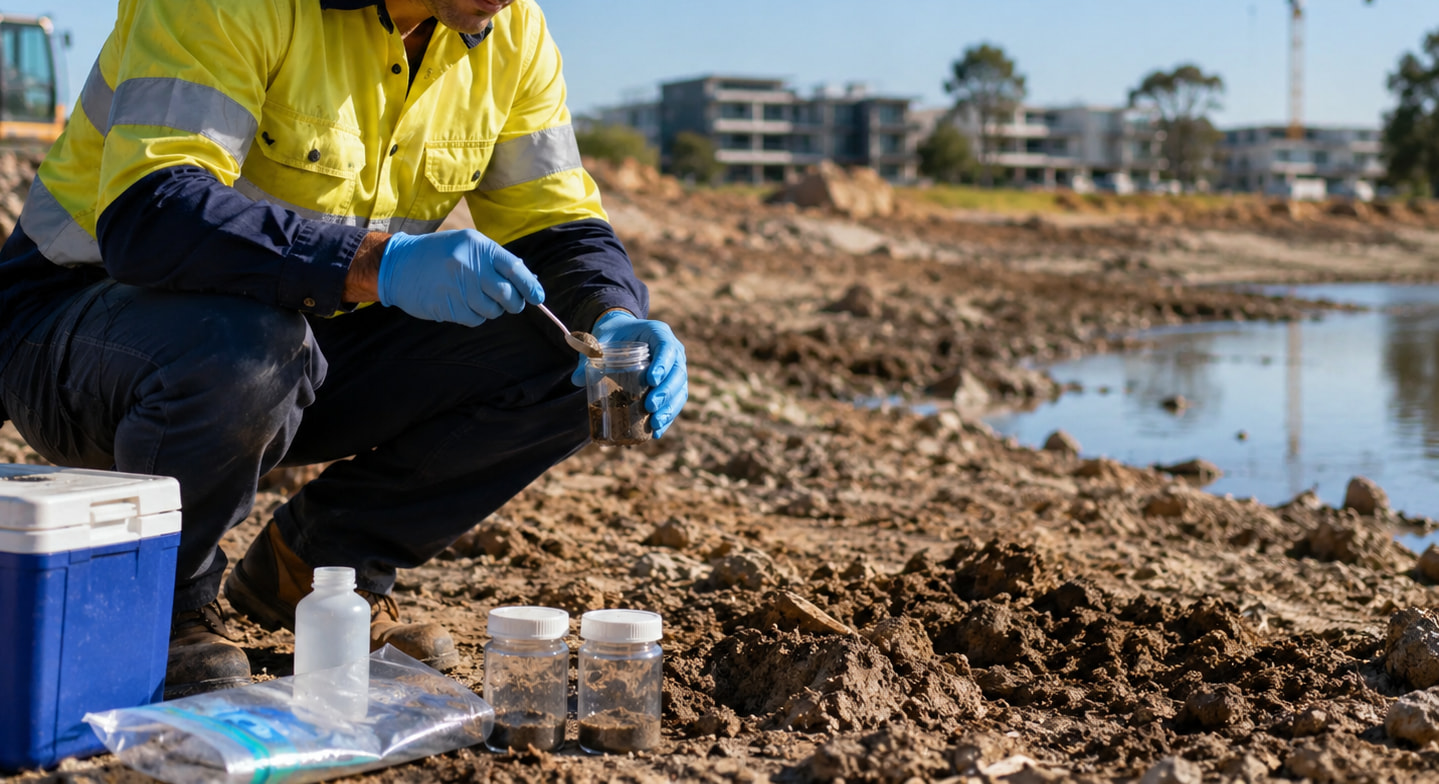
The cheapest PFAS problem is the one you find early. A preliminary site investigation that reviews land history and identifies potential PFAS sources can tell you whether further sampling is warranted before you commit to a purchase or lock in an excavation method. Where contamination is confirmed, a clear assessment against current criteria gives you the evidence base to plan remediation, classify waste correctly, and satisfy regulators, lenders, and buyers.
The regulatory tightening through 2025 and 2026 is not a reason to panic. It is a reason to get ahead of the question on your sites, with assessment that reflects the rules as they stand now.
BBN Consulting provides contaminated land assessment and environmental due diligence across Queensland, designed around the current PFAS framework. If you have a transaction, development, or remediation project where PFAS could be in play, talk to BBN before ground is disturbed. Get in touch or call 0410 170 853.
Frequently asked questions
What is the PFAS NEMP?
The PFAS National Environmental Management Plan is Australia's national guide for managing PFAS contamination. It is developed jointly by the Commonwealth, state and territory, and New Zealand governments through the Heads of EPA Australia and New Zealand, and it shapes how regulators and consultants assess contaminated sites across the country.
What changed in NEMP 3.0 and NEMP 3.1?
NEMP 3.0, released on 4 March 2025, introduced revised health based and ecological guideline values for soil, surface water, groundwater and biota, and placed stronger emphasis on treating PFAS rather than disposing of it to landfill. NEMP 3.1 incorporates updated guideline values for PFOS in fresh and marine water, following the revised ANZG values released in March 2026.
Does a past clean result still stand?
Not necessarily. A concentration that passed an assessment under earlier criteria may exceed current values, which can change a site's classification, its permitted land use and the cost of making it development ready. Lenders, insurers and regulators are increasingly alert to that gap.
Which sites are most likely to carry PFAS?
Former industrial premises, fire training grounds, airports, defence land, waste facilities, and properties downgradient of any of these. PFAS can be present with no visible sign at all, surfacing only in a soil or groundwater sample.

.jpg)